
The word plankton often brings to mind something too small to see. Size is part of many familiar examples, but drifting is the more useful starting point.
Begin with the movement
NOAA’s introduction to plankton explains that these organisms are carried by currents and tides and cannot swim strongly enough to overcome that transport. Some remain plankton throughout life; others belong to the group during an early stage.
The category includes microscopic organisms as well as larger animals such as some jellyfish. It is not the name of a single species.
Use a diagram as a question
Draw a current arrow and place an unnamed organism beside it. Ask whether the label in your source describes its size, its way of feeding, or its relationship to the moving water. These are different kinds of information.
A photograph without scale may not answer the first question. A still image alone may not answer the last.
Keep the coastal view in perspective
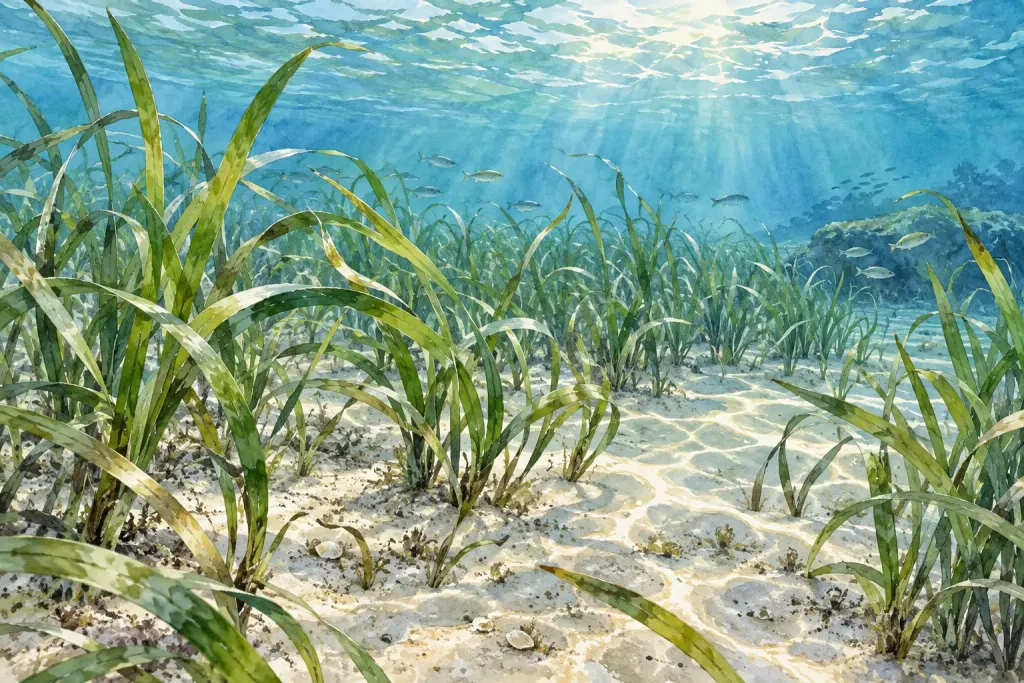
Looking across apparently clear water is not a survey of the organisms present. Avoid turning the absence of visible specks into a conclusion about an entire ecosystem.
Read alongside what water clarity can show. The useful shift is from searching for one familiar-looking creature to asking how a source defines the life it describes.