
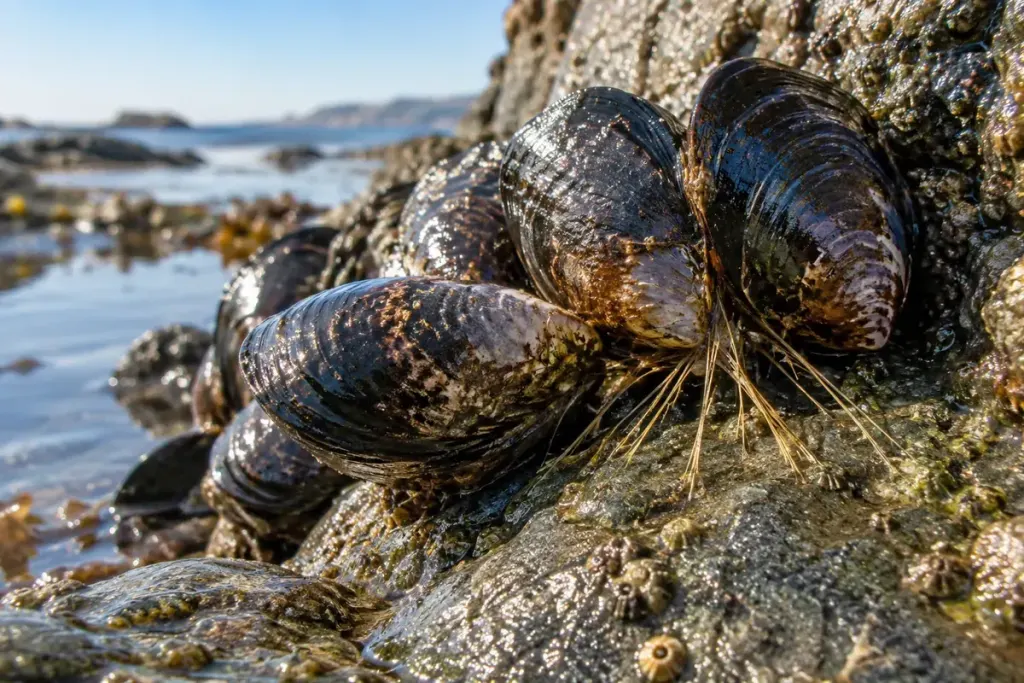
A cluster of mussels can look almost planted on the shore. The fine strands around their attachment points invite that comparison, but they are not plant roots. They are part of how the animal stays attached to a surface.
Observe the connection without testing its strength
The strands commonly called a mussel’s beard are byssal threads; the Oregon Coast Aquarium’s California mussel profile explains their attachment role. In a suitable close photograph, trace a thread from near the shell toward its contact with the surrounding surface. Some may be hidden beneath neighbouring mussels, sediment or seaweed, so a visible cluster does not reveal every attachment.
Do not pull a living mussel away to improve the view. An educational specimen, a museum image or a carefully labelled photograph can answer a structural question without disturbing a shore community. Remain on safe, permitted routes and do not treat low tide as a guarantee that every exposed rock is safe to reach.
Keep appearance and function separate
Make two notes. In the first, describe the strands you can see: fine, clustered, extending between shell and surface. In the second, record the explanation supplied by a reliable marine reference. That arrangement prevents a root-like appearance from silently becoming a botanical claim.
A useful follow-up question is what surface the animal is attached to: rock, another shell or an artificial structure. Include that context in the caption. The same small feature becomes more informative when you keep the animal, its attachment and its immediate surroundings in one observation.
AI-generated editorial illustration; not a documentary photograph.