
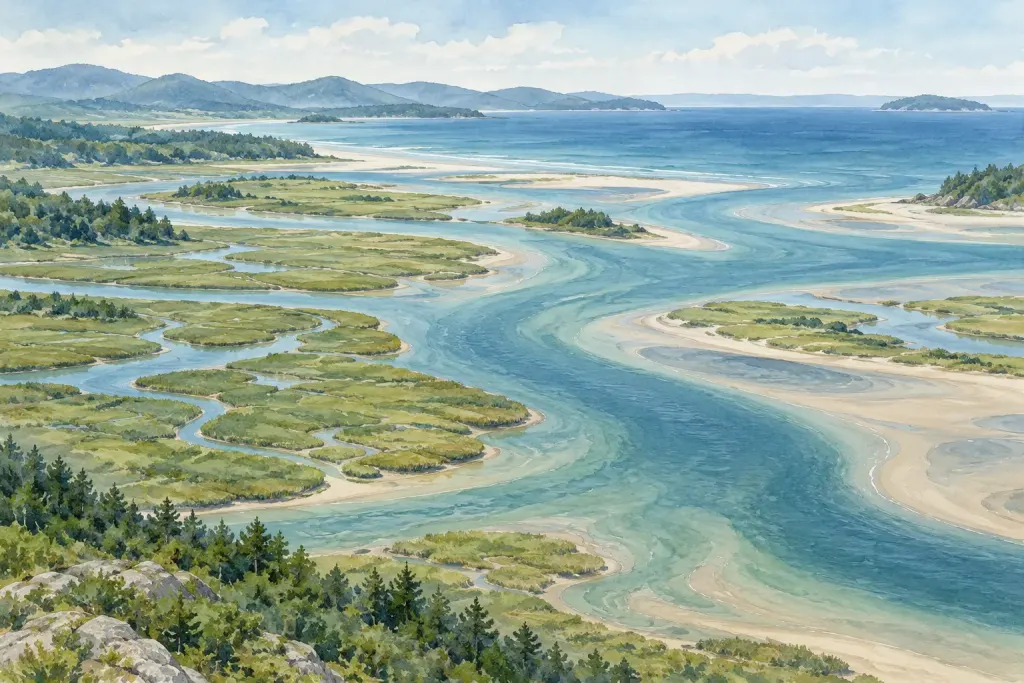
A map gives an estuary a name and an outline. It does not give every part of the water the same conditions. A reading taken near a river and another near the sea may describe different mixtures, even on the same day.
NOAA’s estuary-monitoring tutorial explains that freshwater input, including changes associated with rainfall or drought, can affect estuarine conditions. It also describes salinity as generally higher toward the ocean entrance and lower upstream.
Attach a reading to its context
When you encounter a salinity figure, look for the location, date, depth and method. A number without that context is difficult to compare with another observation.
Ask whether the source reports a single measurement, a range or a summary over time. These answer different questions.
Think about connected water, not a fixed boundary
An estuary is a meeting and mixing environment. The line between “river” and “sea” on a simplified diagram can make that interaction look tidier than the real setting.
Use the diagram as an introduction, then look for monitoring information that shows variation. Avoid inferring exact conditions from the colour of water in a photograph.
Keep biological claims specific
NOAA notes that organisms differ in their responses and tolerances to salinity changes. That does not mean one reading can tell you which species must be present or whether a whole habitat is healthy.
For a species-level claim, look for appropriate local evidence rather than extending a general description too far.
Read comparisons carefully
If two reports appear to disagree, first check whether they measured the same part of the estuary under comparable conditions. A difference may reveal a changing system rather than a mistake.
Our estuary introduction provides the larger picture. The useful habit is to read every environmental number with its place, time and method still attached.