
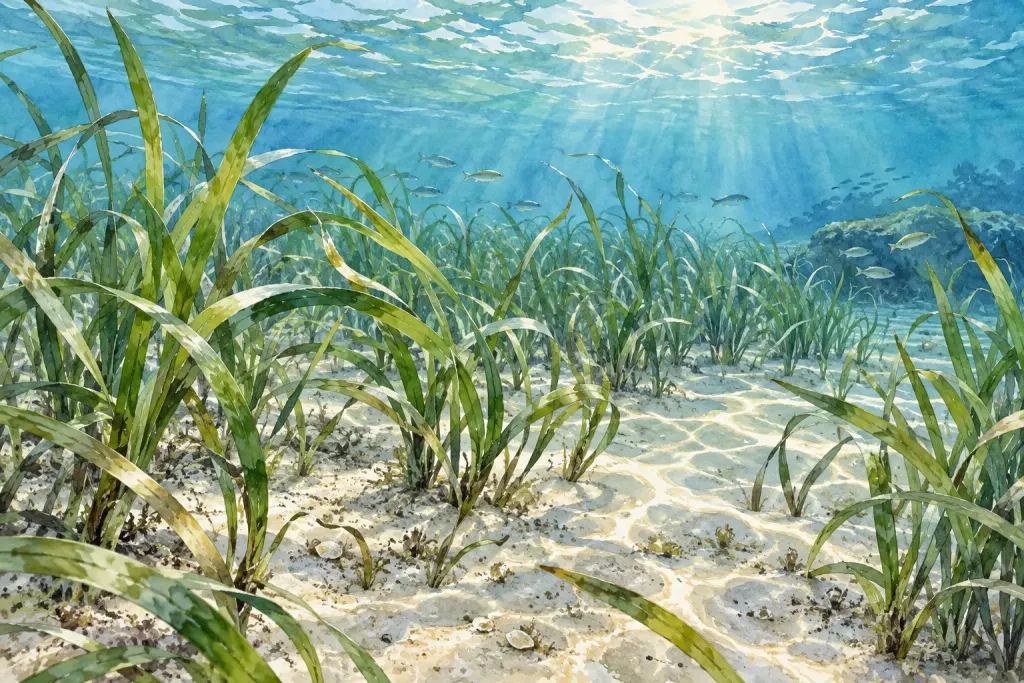
A green underwater meadow can be easy to overlook beside a dramatic reef. Yet the word “grass” points toward something worth noticing: seagrasses are flowering plants, with a structure and way of life that differs from the algae commonly called seaweed.
More than a green shape
NOAA’s seagrass overview describes plants with roots, leaves, flowers and seeds that live submerged in shallow coastal water. They need light reaching the seabed and can form meadows in sheltered bays, lagoons and estuaries.
A meadow is also habitat. Its blades can shelter small marine animals, slow moving water and trap sediment, while belowground structures help stabilise the seabed. Seagrass systems also store carbon. The amount and condition vary; a photograph cannot measure these functions.
Why the distinction matters
Calling every underwater green patch “seaweed” hides different organisms behind one casual label. It is a little like calling every green thing in a garden a tree. The comparison is only a prompt for careful vocabulary, not a botanical classification.
When reading an article, look for a named plant or habitat and a source explaining the identification. If the image is illustrative, treat it as an introduction to the idea rather than evidence that a particular species was observed in that location.
Ask about the conditions around the meadow
NOAA identifies pressures including poor water quality, coastal development and damage from boats. Reduced light can affect growth. Learning about those pressures is more informative than judging a meadow’s health from whether a single image looks bright green.
Try a two-column reading note. In the first column, write the claim: “the meadow is recovering,” for example. In the second, write the evidence supplied: a survey, a time series, or only a photograph. Leave the second column incomplete if the article provides no basis for the conclusion.
Put the habitat back in its landscape
A seagrass meadow does not exist separately from water arriving from land or activity along the shore. Our estuary introduction offers a way to think about those connections. The more useful question is often not “what is that green patch?” but “what allows this habitat to keep functioning?”