
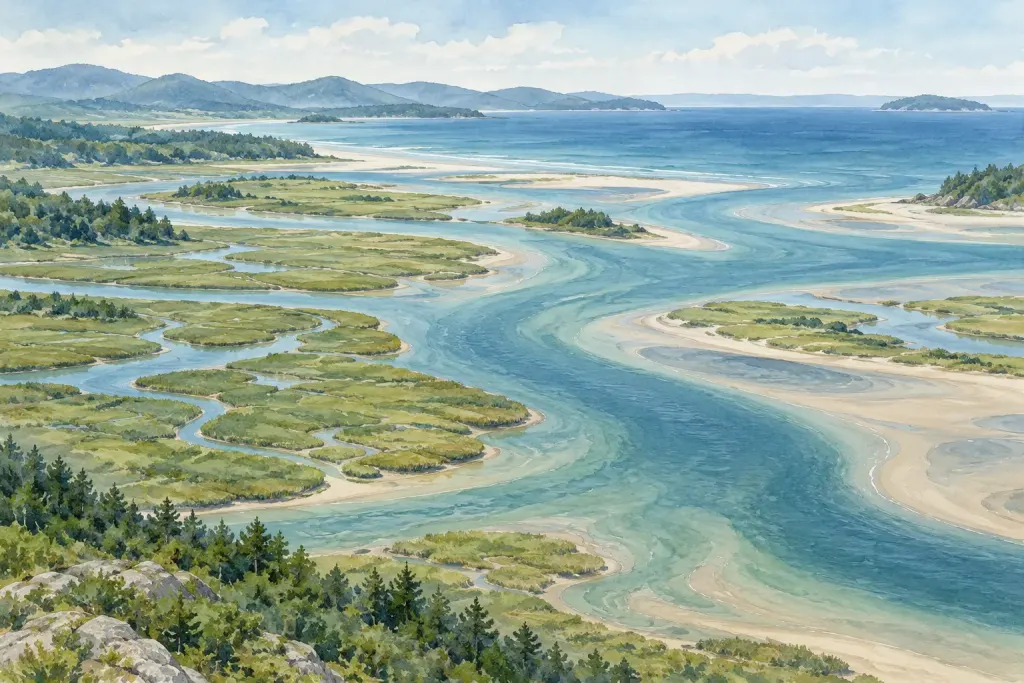
From a distance, a beach looks like one continuous surface. Up close, the sediment may contain grains that differ in colour, shape and texture. “Sand” describes a familiar material at the shore, but it does not give every grain the same origin story.
Start with the range of possible sources
The US National Park Service’s guide to coastal sediment parent material distinguishes sources that include rock and mineral material as well as biologically derived fragments. Which sources matter at a particular beach is a local geological question.
Do not identify a grain solely because its colour resembles a photograph in a general guide. Weathering, mixtures and the limits of a casual view can complicate the comparison.
Make a visual note without collecting
From a permitted, safe place on the shore, look at a small patch without disturbing habitat or removing material. Note whether its visible grains look uniform or mixed. A photograph can preserve the patch and its setting, provided it does not imply microscopic detail the image cannot resolve.
Use words such as pale, dark, rounded-looking or angular-looking when those are the observations available. Leave mineral names for evidence that actually supports them.
Follow the question toward a local explanation
Look for a park, museum or geological organisation’s account of the coast. Does it identify nearby rock sources, shell material or sediment transport? Keep the specific beach and source together in your notes instead of applying one coast’s explanation everywhere.
Our article on adding context to a shoreline photograph helps preserve the location and conditions. The result can be a small but satisfying observation: this patch is more varied than it appeared from the path, and its variation gives you a concrete question to research.