
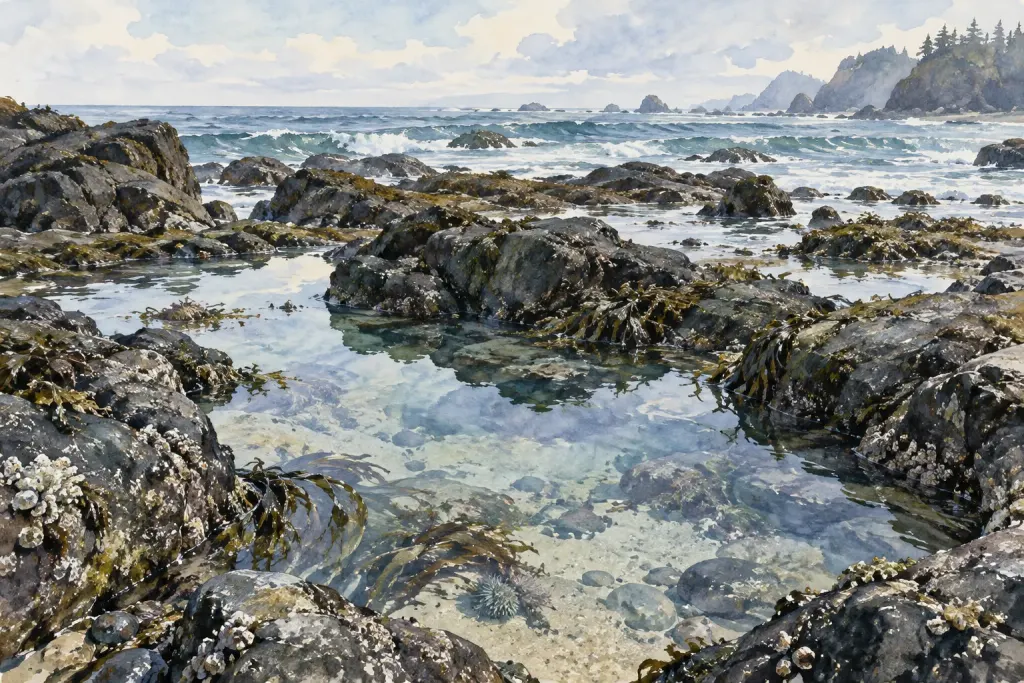
A crest travels across the bay, and it is easy to imagine the water beneath it travelling the entire distance as one moving ridge. The visible pattern is more complicated than a parcel of water sliding from one end of the view to the other.
Thinking separately about a pattern and the material carrying it is a useful first step. It also helps explain why a short shoreline video cannot tell us everything about the water’s movement.
Start with energy and motion
NOAA’s introduction to ocean waves explains that waves transmit energy through water and that wind commonly creates surface waves. This does not mean water never moves from place to place: currents, breaking waves and other coastal processes matter too.
A simple analogy is a ripple of movement passing along a line of people who briefly raise and lower their arms. The pattern advances while each person stays near their place. The analogy is limited, but it separates the two questions: what is travelling, and what is moving locally?
Describe what you actually watched
From an established public viewpoint, choose a fixed feature such as a distant post already visible in the scene. Note the changing surface around it without trying to measure a current from appearance alone. Do not enter the water or approach an exposed edge to improve the view.
You might write, “Several crests passed the post while the bright patch on the surface changed shape.” That is an observation. “The same water moved across the whole bay” adds an explanation the view may not support.
Leave drifting objects out of the shortcut
A floating object can respond to more than the passing wave pattern. Its route is not a simple diagram of how every nearby bit of water moves. Record what it did if relevant, but do not use it to decide whether entering the water would be safe.
The same care applies to a still photograph: it captures a surface at one moment, not a complete account of motion. Pair it with a few lines of coastal-photo context, including where you stood and roughly how long you watched.
An honest shoreline note can end with a question. Separating wave appearance from water movement gives that question a clearer shape, even when the answer requires measurements beyond a casual visit.