
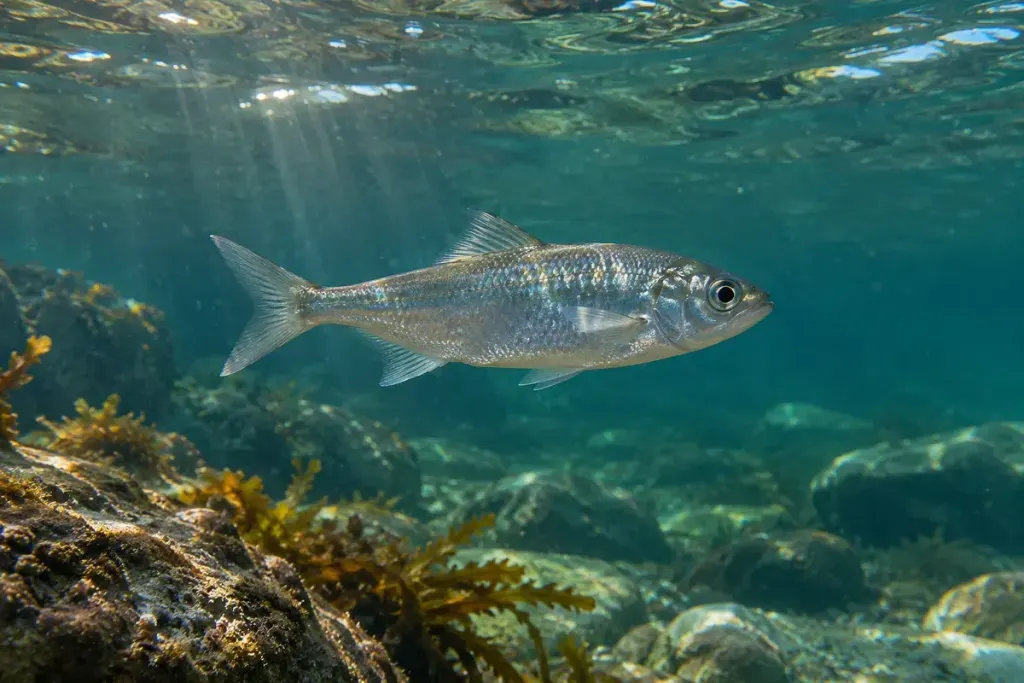
A fish can seem to hang in the water as if an invisible shelf supports it. Look closely, though, and the fins may still be making small adjustments. Holding a depth involves both the body’s buoyancy and the movements that keep the animal positioned.
Buoyancy is the upward force exerted by the surrounding water. Whether an animal tends to rise or sink depends on that force relative to its weight. A body close to neutral buoyancy needs less continuous effort to resist rising or sinking than one strongly inclined to do either.
One solution is a gas-filled space
Many bony fish have a swim bladder, a gas-filled organ that helps regulate buoyancy. It is not an extra fin pushing the animal upward. By changing the relationship between body volume and weight, the gas space helps the fish maintain a depth. This is a useful general explanation, not a description of every fish or every bladder’s additional functions.
Sharks offer a contrasting example. The Smithsonian Ocean account of sharks explains that they lack the swim bladder found in many bony fish. Their buoyancy involves other features, including an oil-rich liver; movement and lift can also contribute. That does not mean every shark must swim continuously. Species differ, and resting sharks are not evidence that buoyancy has stopped working.
Try watching the corrections
At an aquarium, choose one fish in an unobstructed part of the tank. Follow it for half a minute without tapping the glass or trying to make it move. Notice whether it stays at the same depth, changes direction, or drifts while its fins continue working.
Make two separate notes: what you saw and what you think might explain it. “Small fin movements while the fish stayed beside a rock” is an observation. “Its swim bladder was filling” is an internal process you generally cannot establish simply by watching the outside.
Then compare another species. A fish resting on the bottom, a midwater swimmer and an animal travelling near the surface need not share the same strategy. Water movement in the exhibit also matters: staying in one place relative to the glass can still involve swimming against a current.
The interesting question is therefore more precise than “How does a fish float?” Ask how this particular animal maintains its position, and which parts of the answer are visible. That leaves room for the diversity hidden behind an apparently effortless hover.