
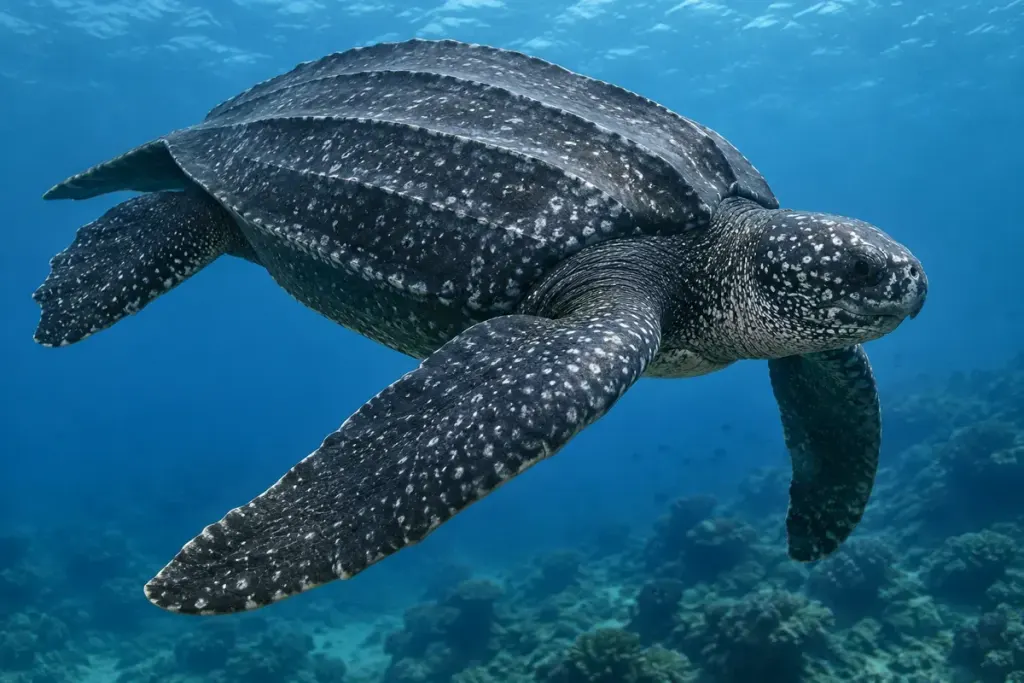
Draw a sea turtle from memory and you may give it a rounded shell divided into large plates. That familiar outline leaves out an important exception. A leatherback’s back looks ridged and skin-covered rather than like the hard, scuted carapace of other living sea turtles.
The difference is more interesting than a colour variation. It is an opportunity to ask what a shell consists of, and to notice when one familiar picture has begun to stand in for an entire group of animals.
Look for structure before assigning a name
NOAA Fisheries’ leatherback species account describes its distinctive leathery covering and the small interlocking bones beneath the skin. The back carries longitudinal ridges rather than the large external scutes familiar from other sea turtles. A different covering does not mean the animal has no supporting structure.
For a desk-based comparison, place an identified leatherback photograph beside an identified hard-shelled sea turtle photograph from a reliable wildlife source. First compare the outlines. Then look at the surface divisions and the direction of the ridges. Keep the source’s species identification beside each picture rather than trying to identify an unfamiliar animal from one feature alone.
A useful sketch can leave information out
Make two small drawings that record only the feature being compared. One could mark the plate-like divisions visible in the reference photograph; the other could follow the leatherback’s lengthwise ridges. Do not add markings merely because they appeared in a cartoon or a different photograph.
Under the drawings, separate observation from explanation. “Lengthwise ridges are visible here” describes an image. “The species has this underlying structure” relies on the biological account. Keeping those statements apart makes it easier to see where your knowledge came from.
The generated image accompanying this article is illustrative. It is not a specimen record, an identification key or evidence of a turtle sighting. Use documented photographs and expert guides when accurate identification matters.
Do not turn an anatomical difference into a handling experiment
Words such as leathery and flexible are descriptions to learn from, not invitations to touch an animal. Observe wild turtles without approaching or disturbing them and follow local wildlife guidance. A stranded or injured turtle needs the appropriate local response organisation, not an attempt to test its shell.
Once you have noticed the exception, return to the original drawing in your mind. It remains a recognisable picture of a turtle, but no longer represents every sea turtle equally well. That is a useful habit for marine learning: let a specific animal complicate the category instead of forcing it to fit the simplest silhouette.
AI-generated editorial illustration; not a documentary photograph.